Caitlin Jans provides some good, common sense tips for reading as a published writer. I had really considered some of these view points.
Thank you for reading,
Ernest
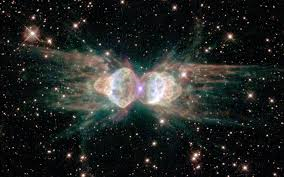
Caitlin Jans provides some good, common sense tips for reading as a published writer. I had really considered some of these view points.
Thank you for reading,
Ernest
The Faphnirains are a type of Saurian. These incredible beings boast two magnificent, enormous wings; strong, clawed legs; and an elegant, serpentine tail. Their two vertically-slit eyes, burrowed delicately in deep-seated sockets, carry an unfathomable air of wisdom and mystery. The gold or green flakes in their iris often whirl, making them appear to be excited. They have superb eyesight. Their hearing is also quite good, though their ears are small and stubby. Faphnirian skin is smooth and thin, covered in small, wide scales in shades of gold, light orange and orange. Their scales tend to become darker as they age.
Faphnirains are an old space-faring race. Rumor and legend say that the crew of a stranded Faphnirian ship may have given rise to the legend of dragons on old Earth.
Their faces appear to be trustworthy, but looks can be deceiving. When angered, their teeth and fangs are capable of biting through durallium alloy. Faphniria is an aristocratic society where the keeping of trophies is normal and expected. Trophies are valued for intelligence, wit, and beauty. The application and interview process to become a Faphnirian Trophy can take years and is an extremely rigorous undertaking.
Geography
The planet Faphniria was named by its discoverer after an ancient legend of old Earth. It is an iron planet in a small solar system with six other planets. Faphniria is about 1.35 times bigger than Earth and its gravity is about 1.90 times that of Earth.
A single day lasts 45.79 hours and a year lasts 462 days. Seven continents make up 58% of the planet’s landmass. Five moons orbit the planet and Faphniria itself orbits a blue sun in a fairly circular orbit.
Intergalactic Visitors
Faphnirains generally discourage visitors as they tend to distract from their pursuits in the arts and sciences. If you wish to inquire about becoming a Faphnirian Trophy, please send a copy of your transcripts showing a Ph.D. in at least three different disciplines, along with some of your peer-reviewed work. Artistic and athletic achievements should be noted as well. All forms of art are appreciated. Music, literature, sculpture, painting, etc. in any style should be submitted with a Galactic copyright attached. Virginity among applicants is preferred.
Seasonal Events and Attractions
Every 13 months, the Festival of Ballet is celebrated with great delight. The Festival features ballet from a dozen different species across the galaxy. Athletic competitions, especially gymnastic, are open by invitation only to the best in the Galaxy. To be invited to perform, or even to attend one of the performances, is a rare honor. The Festival is officially celebrated for eight days, but decorations are often seen weeks before the actual celebrations.
Every four years, the Festival of Dragons is celebrated with excited hearts. It’s a holiday with mythical roots, but today the celebration revolves around watching a beloved natural phenomenon – blowing smoke rings and amazing pyrotechnic displays. It is officially celebrated for eleven days, but the final celebrations often last deep into the night and even into the next day. Only Trophies have ever beheld its wonders.
Thank you for reading,
Ernest
Crawford Tillinghast one of the most notorious scientist in Lovecraft’s tales. In addition, Tillinghast is one of the most easily identified relative to science fiction or weird fiction in general. Tillinghast is the “mad genius” scientist. While Tillinghast may not be first of this character type to appear in weird fiction, he is certainly one of the first relative to application of “modern,” early 20th century science and the attitudes the general public had toward science.
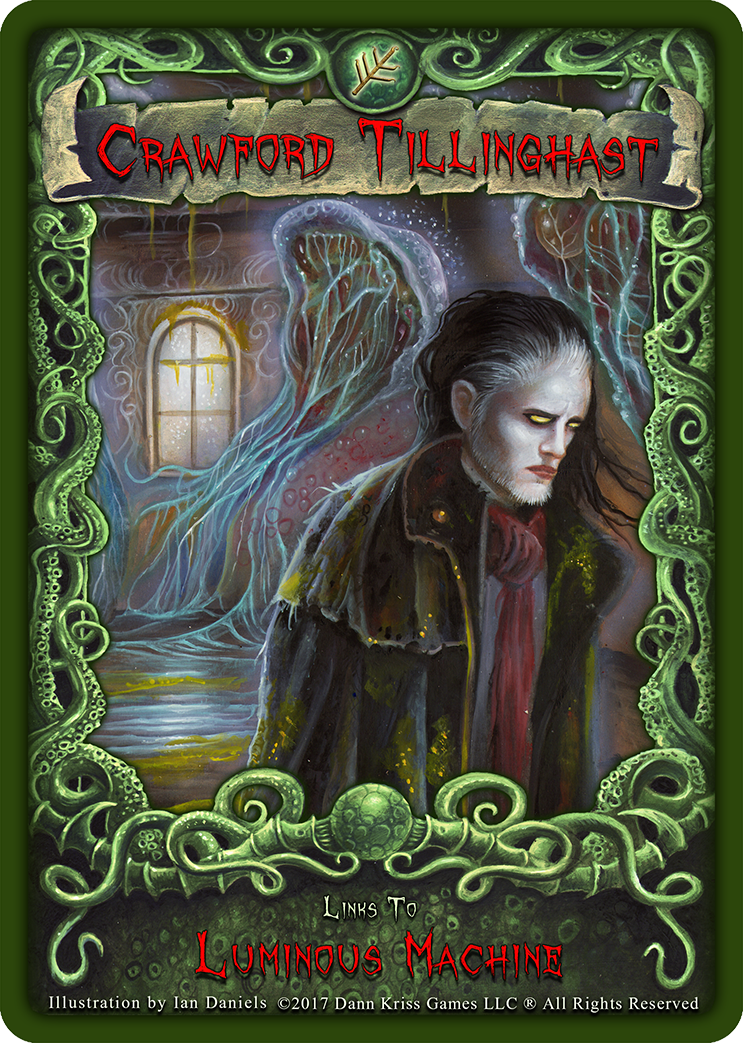
First, is it very easy to compare Tillinghast to Frankenstein, however, I would caution one to understand that this comparison is more appropriate for Dr. Frankenstein in the 1931 Universal movie rather than Mary Shelly’s novel. In Shelly’s novel Frankenstein is more of a metaphysical scientist, whose creation of a man is a broader line mix of alchemy and science. In addition, Frankenstein in the novel is more of a narrative of someone…
View original post 924 more words
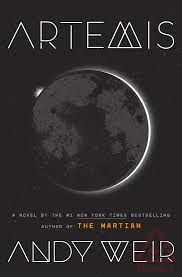
A very good spoiler-free review. If you liked the Martian, book and/or movie, and were wondering about Artemis, this may help you decide.
Rate: 4.5/5
Medium: Kindle
Overview (No Spoilers):
It has been quite a long time since I’ve been so absorbed within a book that I was compelled to literarily devour it from cover to cover within twenty four hours. Artemis, chock full of action from page one, will quickly draw the reader in for an out of earth adventure on the moon colony that shares the name of the novel. Weir’s second novel doesn’t disappoint, especially having to follow up the wild success of his debut novel, The Martian. The Martian was my first book every reviewed on The Critiquing Chemist, and I hesitated to link my review because my formatting has evolved so much from day one. It almost makes me want to reread The Martian so I can update the formatting of a book I so thoroughly enjoyed. Regardless, based on my initial love…
View original post 1,096 more words

The Blood in Snowflake Garden
Author: D. Alan Lewis
Narrated by: Clark Clayson
Christmas can be murder, a murder most foul. Murder and a note from S. Claus, pleading for help, was the only thing which could draw retired Inspector Max Sneed back to active duty. A duty to investigate the murder of the North Poles Premier. Robert Watson, sent by a London paper to write about the jolliest place on Earth, is put instead straight to work by Max. In a twinkling he finds a merry chase through Civil Rights, Labor Disputes and Cold War politics. Robert’s sugar-plum laced pipe dreams of the cheeriest city on Earth are quickly shredded. The more Max and Robert slog through the sleazy, underbelly of the North Pole, the thinner the ice upon which they stand. This murder investigation is rife with a delicious trail of red-herrings, each with the lustre of new fallen snow. Do you want to know the secret history of Santa? How the city at the North Pole was founded? What is it about cupcakes? Once you know the answer, you may never see pastries the same way again.
The answer to these questions, and many more, will impact the world. The Cold War is heating up at the pole. Whoever is in charge at the North Pole could change the course of history. What is the connection between electronic toys and the military base proposed outside the warm zone?
The Blood in Snowflake Garden is one D. Alan Lewis’s earlier books. As such, while this tale does have a few rough edges compared to his later books, the visions within will dance in your heads. His talent for blending real world historical events combined with a different take on a well-known mythology will satisfy your sweet tooth for knowledge. Though you be in ‘kerchief or cap, and settled down in your bed, the last thing you will be taking is a long winter nap. Thoughts of all else, except what lies upon the next page, fly away like the down on a thistle.
The narrator, Clark Clayson, has just that right tone to bring the necessary grittiness upon the breast of the new-fallen snow sprinkled throughout the story. Switching easily between the world weary detective and the wide eyed reporter, err..journalist, to The Jolly Old Nick himself, Clark’s narration helps to create an alternate history you can believe as the tale is unraveled. His enunciations are clear and there is no background noise. His voice is the little old driver of the tale by which soon you will know, there is nothing to dread.
DISCLAIMER: I received a copy of this book for free in exchange for writing a review. I was not obligated to give a positive review, and all thoughts are my own.
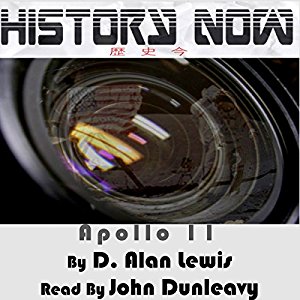
History NOW!: Apollo 11
Author: D. Alan Lewis
Narrated by: John Dunleavy
Historical documentaries are a favorite of mine. History Now! is a nice twist on them. How do the documentarians in this story know what really happened? A trusted few are granted access to time –ships. These Chrono-journalists carefully record and document the events they witness. At least the ones they witness in that particular time stream, for slightest change could send ripples through time changing the very event witnessed.
This story tells the tale of mankind’s first landing on the moon. Did you ever wonder what may have sparked the tale of aliens on the moon? Jace Vern, Chrono-journalist, might be have an answer. Most consequences can be predicted but as Jace says, “It’s always something you don’t think about that bites you in the ass.” Or in this case, it bites us all.
As we learn in the end, even as we try to remember our past and learn from it, the past always has a way of returning. For those who chronicle history are doomed to stand by helplessly while everyone else repeats it. We can only be glad the DaVinci accords of 2218 are in effect preventing everyone from re-writing history in their image.
John Dunleavy provides the perfect voice for a documentary. His enunciations are clear, though a little gravelly, which for the nature of this story provided a bit of gravitas. You can clearly distinguish which character is speaking. There were no background noises to distract from the story.
History Now!: Apollo 11
DISCLAIMER: I received a copy of this book for free in exchange for writing a review. I was not obligated to give a positive review, and all thoughts are my own.
Thank you for reading,
Ernest

Keely: A Steampunk Story
Author: D. Alan Lewis
Narrated by: Phillip Mays
A new synonym has been found for Hope. That word is Keely.
Keely: A Steampunk Story from D. Alan Lewis is an excellent short tale of adventure and romance. In Humanity’s darkest hour a star falls from the sky. Told from the perspective of Thomas Layborne, whose inventiveness are all that stand between Fortress Britain and defeat by an alien invasion, nurses our one true hope back to health. Her innocent discovery of the world is a delightful contrast to the cloud of gloom nibbling on the human spirit, Keely blossoms into a beacon of hope. For the human race in general and Thomas Layborne in particular.
I admire Alan’s craft in the steampunk genre. His character developments, both of the main and supporting characters, are what drive the story. While definitely Steampunk, the technology is not the driving force of the story, it is second to his characters. All of whom are delightful.
A story, whether print or audio, is a doorway into a theater, the theater of the mind. Alan’s characters may drive the story; it is his masterful descriptions which show you the story. These elements woven together create an experience you will not soon forget when you have reached the climax. Keely: A Steampunk Story is engaging through its humor, compassion and adventure. I do not know I have seen anyone else consolidate so much into a short story.
The narration for Keely: A Steampunk Story is excellent. Phillip Mays has a smooth delivery and great tonal qualities. There was never a question what character was speaking or what they were feeling. Male or female, you had no doubt their emotional state. No background noises and though I could hear him swallow a couple times, but as with his pauses, just made me more comfortable listening to him. While I am not generally a fan of audio books, I would listen to more books narrated by Phillip Mays.
DISCLAIMER: I received a copy of this book for free in exchange for writing a review. I was not obligated to give a positive review, and all thoughts are my own.
Thank you for reading,
Ernest


 When My Worlds Collide